
Bonnie and Clyde heist in Ponchatoula
If this crime was perpetrated by another couple, who were they?
Last week, my wife and I visited the “Bonnie and Clyde Ambush Museum” in Gibsland, Louisiana. The place leans into the gore and sensationalism of their murder more that I like. Afterall, the police officers who killed the couple acted as judge, jury, and executioners. In Louisiana, that’s against the law.
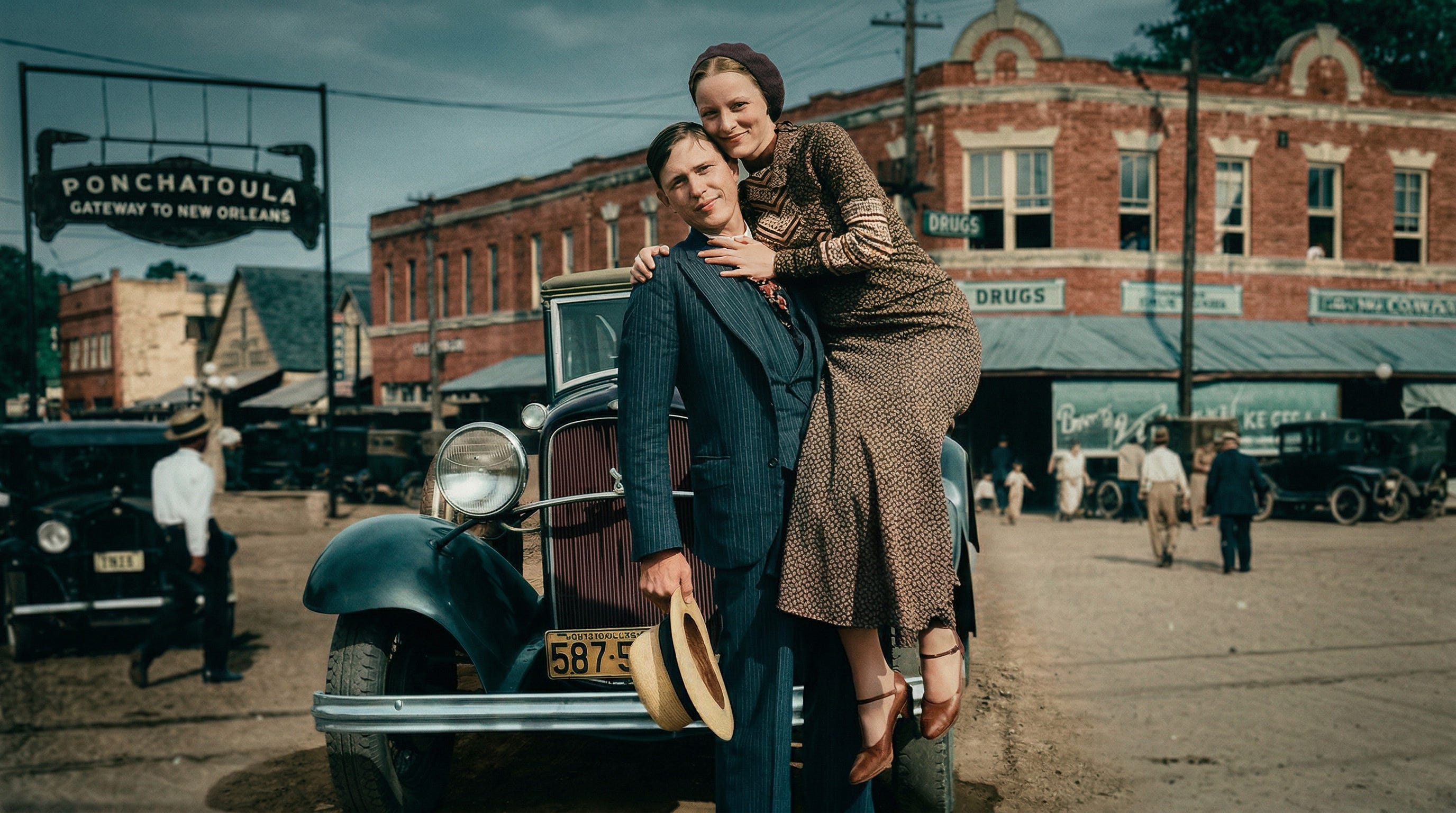
That said, the visit reminded me of this incident…
ON SEPTEMBER 1, 1932, two bandits with shotguns forced W. E. Mount, president of the Merchants & Farmers Bank of Ponchatoula, into his car along with his two daughters. Ruby and Clarabelle were eleven and twelve years old.
What followed was a running gunfight past Springfield, a roadblock of three hundred armed citizens and deputies, and four days of searching through Livingston Parish swamp. The kidnappers were never caught.
Mount told the sheriff his captors were two young men. Several people near the roadblock said otherwise. They insisted the driver of the green sedan was a woman.
One witness, Springfield druggist Estelle Coates, did not hedge. She positively identified the driver as Bonnie Parker.
I first heard this story in 1979, when I was writing for The Hammond Vindicator alongside Mildred Furbos, whose father had owned the paper for more than four decades. George B. Campbell ran The Vindicator from 1919 until he sold it in 1966. He was best known for a folklore column called “The Stroller” — who bought a new automobile, who had a child, who wasn’t cutting their grass. Hammond life in simpler times, C. Howard Nichols, a retired Louisiana history professor at Southeastern Louisiana University, once told me it was “a wonderful window on life in Hammond.”
By the late seventies, Bryan T. McMahon owned the weekly. He gave me use of a back office in exchange for cleaning out decades of accumulated storage. Miss Milly was helping me sort through it when we found a large flat green linen box shoved deep in the shelves.
“Oh my goodness,” she said. “This was Poppa’s. We thought it long gone.”
Inside were newspaper clippings taped to sheets of blank newsprint — scrapbook pages without the binding. The second sheet held a wanted poster for Bonnie Parker and Clyde Barrow.
Miss Milly said the poster had once hung in the Springfield Drug Store. Estelle Coates had given it to her father in 1932. She had wanted Campbell’s help proving that Bonnie and Clyde had taken W. E. Mount and his girls. Mount himself refused to name his captors. He was afraid of what would happen if he did.
The clippings in Campbell’s box told the story this way:
“Two bandits, foiled in attempts to kidnap W. E. Mount, president of the Merchants & Farmers Bank of Ponchatoula, along with Mr. Mount’s two small daughters, were believed to be hiding in the woods west of Springfield in Livingston Parish, after shooting their way through a roadblock with both citizens and deputies returning fire. The bandits are known to have shotguns and may have at least one machine gun. Posse-men were told to take no chances and shoot on sight, but deputies report the pair disappeared and theorized they might have blended secretly with their posse of over 300 men and women.”
The clippings described Mount’s account of the abduction: he had fought both captors in what he called a long, strenuous tussle. He got free just a mile outside of Ponchatoula, pulling his daughters out of the car with him. A neighbor saw it happen and fired a shotgun over the bandits’ heads. They sped off. The neighbor telephoned Springfield and warned the town.
Deputy Sheriff Bud Sullivan parked a large flatbed truck across the highway between Ponchatoula and Springfield. When the green sedan came through, both bandits were shooting. The crowd returned fire. The car went into a ditch, kept going, and made it into Springfield. It was found abandoned a quarter-mile west of town. Texas license plates. The car had been stolen three months earlier.
Two months after the kidnapping, New Orleans police arrested a gang of six would-be bank robbers. Sheriff’s deputies escorted Mount to the city to see if he could identify any of them. He could not.
According to Campbell’s scrapbook notes, Estelle Coates insisted until her death that the driver was Bonnie Parker. Every witness interviewed about the passenger described a tall, slender, clean-shaven man with brown hair. That was an approximate description of Clyde Barrow in 1932.
In the 1990s, Nicholas R. Murray leased The Vindicator from owner Harrel Griffith and brought me back to work for him. The paper had moved buildings by then. Miss Milly had retired long before. I asked Murray about the green linen box.
He grinned. Miss Milly had the box, he said, but she had let him scan its contents. He had spent months tracing the names in the clippings, tracking down descendants of everyone mentioned. Like Campbell before him, he hit a wall.
Whether or not Bonnie Parker was the woman behind the wheel on Highway 22 that September morning, she and Clyde Barrow met their end at a Louisiana roadblock not so different from the one at Springfield.
Just before dawn on May 23, 1934, a posse of Louisiana and Texas lawmen hid in the brush along a highway near Sailes, Louisiana, and waited. A stolen car came around the bend. The driver tried to go around the blockade. The posse opened fire.
Bonnie and Clyde died instantly.
The September 1932 roadblock near Springfield let them go. Nobody has ever been certain whether that was them or not. W. E. Mount went to his grave without saying.
If any descendants of Estelle Coates, W. E. Mount, Ruby or Clarabelle Mount, or Deputy Bud Sullivan have information, documents, or photographs connected to the September 1, 1932 incident near Springfield and Ponchatoula, contact me through the Bayou Justice column. That green linen box full of clippings is still out there somewhere. Somebody always knows something.


