
Legendary voice names killer in 911 call
The murder of Rube Rogers
ON AUGUST 14, 2010, a white pickup truck swung into the parking lot of a Days Inn in Hurricane Mills, Tennessee. Seventy-five miles west of Nashville. The man behind the wheel signed the registry as “Rube Rogers” and paid with a credit card in that name.
In his room, he rolled a marijuana cigarette. Then he picked up the phone and called the ranch of Country Music legend Loretta Lynn.
The man’s name was Eric Maurer. He was 31 years old. And less than twelve hours earlier, he had shoved Rube Rogers down a stairwell and drawn a kitchen knife across his throat.
If you’ve spent any time at all in southeast Louisiana and you haven’t heard the name Rube Rogers, you haven’t been listening.
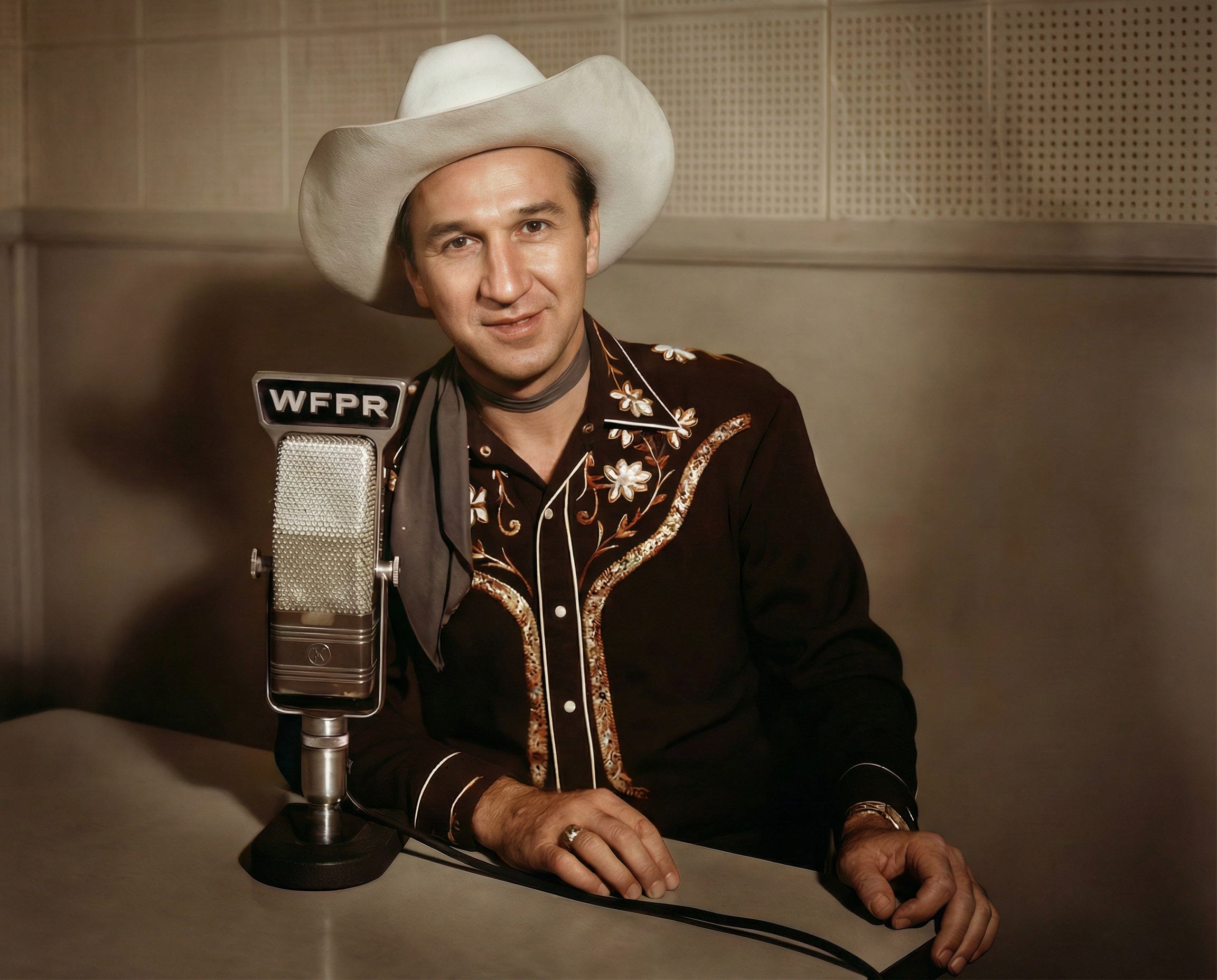
Cash Box Magazine caught wind of him first. September 24, 1960:
“We just got wind of an interesting incident that happened out Louisiana way. It seems there’s this kid announcer at WFPR in Hammond, Louisiana, by the name of Rube Rogers — affectionately tagged as the original Country Boy — who heard about the closing of the Louisiana Hayride and got busy on the phone contacting country artists all over these United States. He got up a package show featuring Red Sovigne and put it on in the Albany High School auditorium, just a few miles from Hammond. After sinking two paychecks into advertising and promotion, old Rube drew a crowd of 1,400 people. Next, he stays up day and night, working up another show, calling that one the Grand Ole Louisiana Hayride. And sure ‘nuff, he puts it over big, drawing some 2,500 people — too many to fit in that auditorium.”
He was 19 years old when Cash Box wrote that.
By 1966, Rube Rogers had drawn the attention of the United States Congress. On July 12th of that year, Louisiana Representative James H. “Jimmy” Morrison entered these words into the Congressional Record:
“Mr. Speaker, it used to be that you would have to go to Nashville on a Saturday night to see and hear good old country western music played by famous artists at the Grand Ole Opry. But this Tennessee monopoly is being challenged as people come from miles around, from anywhere and almost everywhere to see Ponchatoula’s pride and joy, the South Louisiana Hayride.”
Morrison went on to describe Saturday nights at the Hayride — crowds of two and three thousand, Louisiana’s governor sitting front row with his family, a radio signal from WFPR carrying the show to over 100,000 listeners who couldn’t get a seat. And there was Rube, opening each broadcast the same way: “Get comfortable, just take off your shoes, you’ll feel better, get the coffee poured around ‘cause here comes the show you have been waiting for.”
By 1968, he was booking acts at the South Louisiana Hayride, the Loranger Opry, and the Old South Jamboree in Walker. His self-syndicated weekly column, the Opry Spotlight, went to papers in six states. That year alone, it covered appearances by more than 200 Opry stars — Loretta Lynn, Porter Waggoner, Willie Nelson, Dolly Parton, Merle Haggard, Conway Twitty, Hank Williams Jr., and George Jones among them.
His voice sold radio commercials at premium rates. Old-timers across Tangipahoa Parish still smile when someone says “Tangi Meats” or “Going to Sunflower” or “It’s Swap Shop time!”
I interviewed Rube for the first time in 1979. He told me his first business wasn’t country music at all — it was a non-profit promoting gospel concerts in Springfield. He talked about Willie Nelson. About Loretta Lynn. And then his voice went flat.
“All I ever wanted to do was help people,” he said. “I thought public service would be the best way to do that. I was wrong. Everybody loves you on the music stage. On the political stage, there’s always someone with a different agenda from yours — and that person will do whatever it takes to bring you down.”
He wasn’t exaggerating. When Jimmy Morrison retired, Rube left the radio station and ran for that Congressional seat. His platform was simple: make Louisiana oil refineries pay their fair share of taxes, and name the politicians taking money from the mob. He lost to John Rarick, who had accepted donations from both Carlos Marcello and Standard Oil.
In 1972, he ran for the Tangipahoa Parish Police Jury. He won that one.
From the Police Jury, he chaired the Tangipahoa Bicentennial Committee. He fought the dredging of Lake Pontchartrain and the gravel mining of the Tangipahoa River. He pushed to widen Highway 22 from Ponchatoula to Springfield and to elevate stretches of I-55 off their old shell base. After leaving office in 1976, his advocacy was mostly responsible for replacing the parish’s police jury system with the current home rule charter.
In 1979, he ran for State Senate and went after the oil companies again.
“Recent oil and gas finds make the energy fields between Clinton and Covington the largest in America, yet our existing severance taxes are the lowest on earth,” he said. “If our oil prices are not brought in line with the world market, the major oil companies will swallow our service station operators, and there will be no more privately owned stations.”
“It’s time our state waged an all-out war on the cause of our social and economic ills: organized crime,” he said.
And again, he lost.
Every legend carries its shadow. August 1967 took his younger brother Billy — a deep-sea diving accident in the Gulf. That same month, fire destroyed WFPR, the station that had made him. In 1980, his 18-year-old son, Carl Edward Rogers, was found near the family home in Pumpkin Center with a .22 caliber bullet in his chest. He had taken his own life.
The following year, armed men walked into Rube’s Interstate Battery store and robbed his son John at gunpoint, along with two cousins, Larry and Terri Rogers.
One week after that robbery, the Tangipahoa Parish Sheriff’s Office returned to the Rogers property. They collected ten marijuana plants and charged Rube with possession and cultivation with intent to distribute. He pled guilty. Suspended sentence, five years. A $4,000 fine.
The timing raised eyebrows. It still does.
Eric Maurer and his twin brother Derrick had lived with Rube since they were ten years old. They had spent summers at Paradise, the Rogers farm south of Highway 22 near the Tangipahoa-Livingston Parish line. Ernest Ray Lynn — Loretta’s son — had known them their whole lives.
That’s who Eric called from the Days Inn. He asked if there was work available at the Lynn ranch.
Prosecutor Brad Berner, of the 21st Judicial District Attorney’s Office, laid out the prosecution’s timeline for twelve jurors:
Around 10 p.m. on August 13, 2010, Maurer caught a ride to Rogers’ home on Paradise Road and entered through an unlocked window.
He climbed to the second floor and confronted Rogers, then kicked him down the stairwell.
He took all the cash from Rogers’ wallet, two credit cards, and the keys to his white pickup truck.
Seeing Rogers on the phone calling 911, Maurer cut his throat with a butcher knife, then stabbed him two or three more times around the neck.
Maurer drove north on I-55, stopped to pick up his father, Ricky Maurer, and kept going to Tennessee.
Father and son were apprehended at the Days Inn in Humphrey County one day later.
Berner played a 911 tape for the jury after lunch. It was garbled. But Rube Rogers’ voice was still on it, identifying “Eric” as the man who had done this to him.
Testimony came from Tangipahoa Parish Sheriff’s deputies and Humphrey County, Tennessee Sheriff Chris Davis. The case Berner built was robbery gone to murder. Calculated, not impulsive.
The jury deliberated less than an hour. On Tuesday, May 28, 2013, they returned a unanimous verdict of second-degree murder. 21st Judicial District Court Judge Doug Hughes sentenced Eric Lane Maurer to life at hard labor, no probation, no parole.
The verdict didn’t close all the doors.
On the record, but away from the jury, came an allegation that Derrick Maurer — Eric’s twin brother — had offered to confess to the killing himself. Eric, meanwhile, told investigators on tape that his father Ricky was the mastermind behind the whole thing.
Neither claim was tested before the jury. The state had its man. Whether they had the full story is a different question.
Rube Rogers spent forty years trying to make southeast Louisiana more honest. He named the mob. He named the oil companies. He named the politicians. In the end, someone who called him family walked through his unlocked window and took everything — his wallet, his truck, and his life.
Somebody out there knows whether Eric Maurer acted alone. If you have information about the death of Rube Rogers, contact the Tangipahoa Parish Sheriff’s Office or reach me through the Bayou Justice column. There’s no case too cold to revisit. Somebody always knows something.


