

The Girl in the Chifforobe
A Phenix City judge married off a fourteen-year-old girl to keep her from the mob in 1941; three years later, hidden inside a closet, she watched a hit man strangle her best friend.

Jesse Wyndon Floyd stands in the Phenix City courthouse, thin and bony behind round spectacles, waiting on his own wedding. He is nineteen, a city clerk, nephew of the man who organized the first city council.
It is a Thursday, May 22, 1941.
His bride comes from 619 South Railroad Street, the gambling side of town. She is raven-haired and blue-eyed. She is also fourteen years old.
Judge Claude Bertram Gullatt has signed licenses like this one before. He barely looks up before he signs this one too.
The paper in front of him lists her birthday as December 7, 1922. She was actually born December 7, 1926, in a carnival tent pitched for the season in Metairie, Louisiana. Her father, Henry Spellman, is a compact man with carnival grease worked permanently into his knuckles, a circus mechanic by trade. Her mother, Josephine, has a soft Georgia drawl and a shape she has already spent years fielding comments about from strange men.
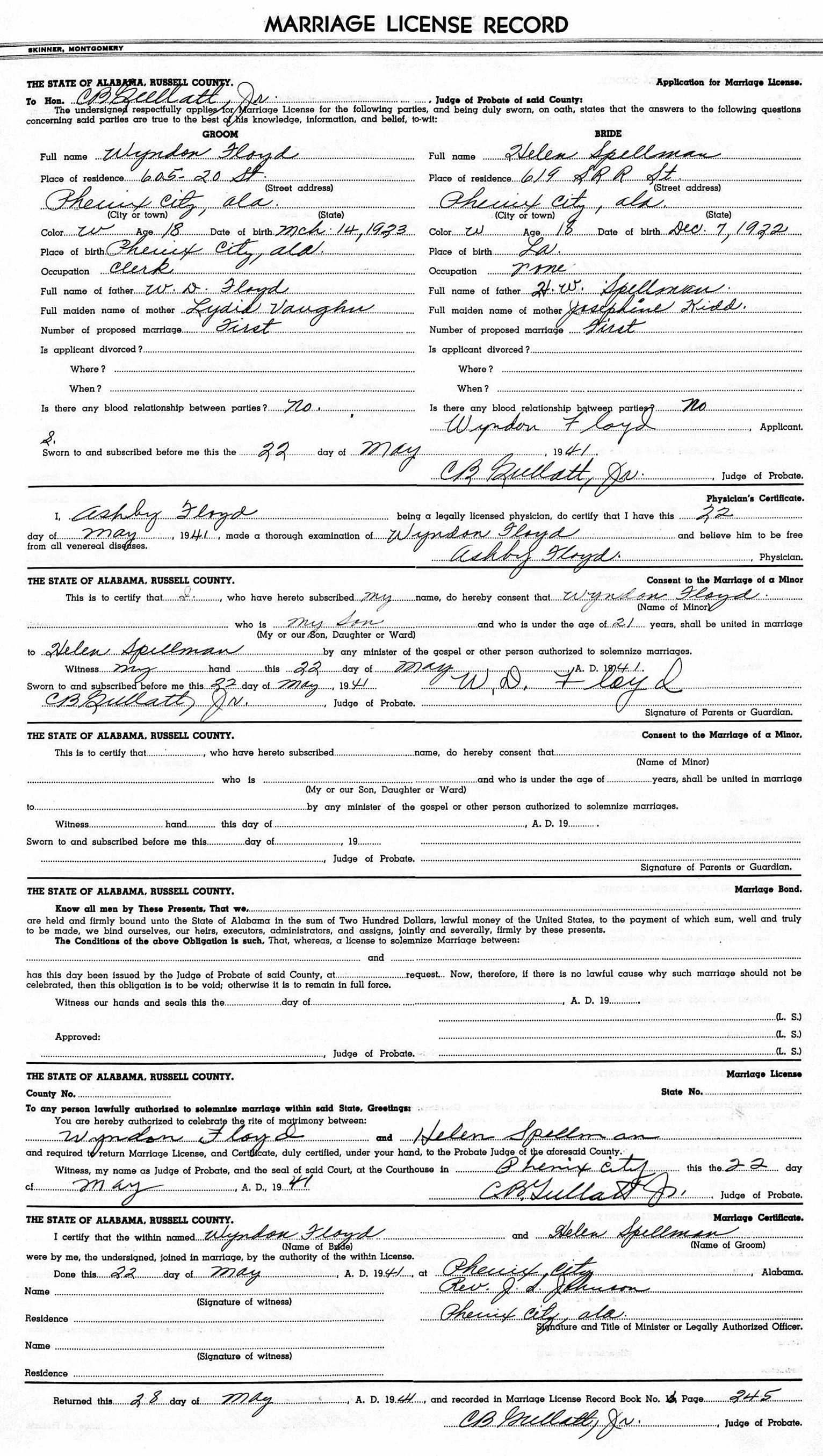
Dr. Ashby Floyd, who has certified more Floyd family arrangements than he can count, signs off on this one too. Reverend J. S. Johnson performs the ceremony without a hitch in his rhythm. Henry and Josephine sign as witnesses to their own daughter’s disappearance from the record.
Nobody at the courthouse calls this a crime. In Phenix City, it passes for a civic function.
Between 1932 and 1954, five families ran Phenix City, passing council seats from father to son the way other families passed down a store. In 1935, with the town sliding toward bankruptcy, the commissioners invited the gamblers in to save it.
It worked. The vice came with the money, and by 1940 nobody pretended otherwise.
“By 1940, Phenix City had no border between good and evil,” Strickland and Wortsman wrote in Phenix City: The Wickedest City in America. “Climb a tall tree, spit in any direction, and where the wind wafted the splutter, you would find organized crime, corruption, sex, and human depravity.”
Henry Spellman ran a bar covertly bankrolled by those same men. Wyndon had watched the girl grow up in that house and feared what it would do to her once she was grown enough to matter to them. He went to his uncle. The uncle arranged a wedding instead.
It was meant to be a rescue.
The newlyweds moved onto the Floyd family property. A year later, the Merchant Marines sent Wyndon touring the Caribbean, and his family, worried for Helen alone in Phenix City, shipped her north to relatives in Iola, Pennsylvania.
There she enrolled at Temple University and studied drama under Luther Conradi. She also joined the Luzerne County Council of Republican Women and the Iola Council of the Daughters of America. She wrote her husband at sea that young people could save the world from what she had seen back home.
Wyndon wrote back with a poem about bombers.
Two-ton bombs loosed from their crane hurl earthwards like eggs of hell,
Fall downward swiftly as drops of rain splatter into dull shrapnel.
He did not tell her he no longer believed what she believed.
In June 1944, Helen came home to Buddy’s Place, her parents’ bar on Cusseta Road in Columbus, Georgia, just across the river from Phenix City. Over dessert, her mother mentioned a family from the old neighborhood. Their daughter, Lonnie, had left her two children with her parents in May and vanished.
Josephine suspected one of the brothels. Helen said she would ask around.
Six days later, she found her.
Lonnie Foster, a tall blonde girl three years Helen’s junior, was tending bar at Boone’s Café under the name Pat. She had married, Helen learned, a man named Dave Walden. Walden had a red crew cut and the build of a carnival strongman, and he made his living killing people for money.
He had married Lonnie only to search her house.
Walden believed Lonnie’s first husband, a Fort Benning night watchman named William Archer, had stolen seventy-five hundred dollars from a safe at the 320 Club, and that Lonnie had killed him for it. A man named Stringfellow had told Walden as much, right before Walden killed Stringfellow too. So far, Walden had found no money in Lonnie’s house.
Lonnie was still telling Helen all of this when a car door slammed outside.
She goes still. “He’ll kill you if he knows we talked,” she says. She pulls open a chifforobe against the wall, and Helen climbs inside.
Through the crack between the doors, Helen can see the whole room. Walden comes in with another man, and the argument starts at once: the money, the safe, what Lonnie does and doesn’t know. Lonnie says she knows nothing and threatens to go to the police about Stringfellow.
Dave Walden puts his hands around her throat.

Helen does not move. She watches through the crack until it is over, and when the men carry the body out, she climbs out of the chifforobe and stands alone in the empty room.
She sobs the whole walk back across the bridge to Columbus.
In Phenix City, a town built and governed by men who had spent a decade deciding what to overlook, no one came looking for Lonnie Foster. Not her parents’ neighbors. Not the police. Not the five families who ran the machine that had, one way or another, arranged everyone’s silence, including a fourteen-year-old bride’s four years earlier.
Three months later, a baby-blue 1942 DeSoto President, borrowed from a Phenix City gambler and never returned, carried Helen, Josephine, and Helen’s half-sister Millie west across the state line for good.
By the time its engine gave out on a rainy street in New Orleans, Helen Spellman had already started disappearing. Stacey Lawrence was about to take her place.
TO BE CONTINUED.