

Three Thousand Eight Hundred Hours
Sheriff Kyle Miers says his detectives still work the Jennings 8 murders daily and have logged 3,800 hours on the case since July 2024

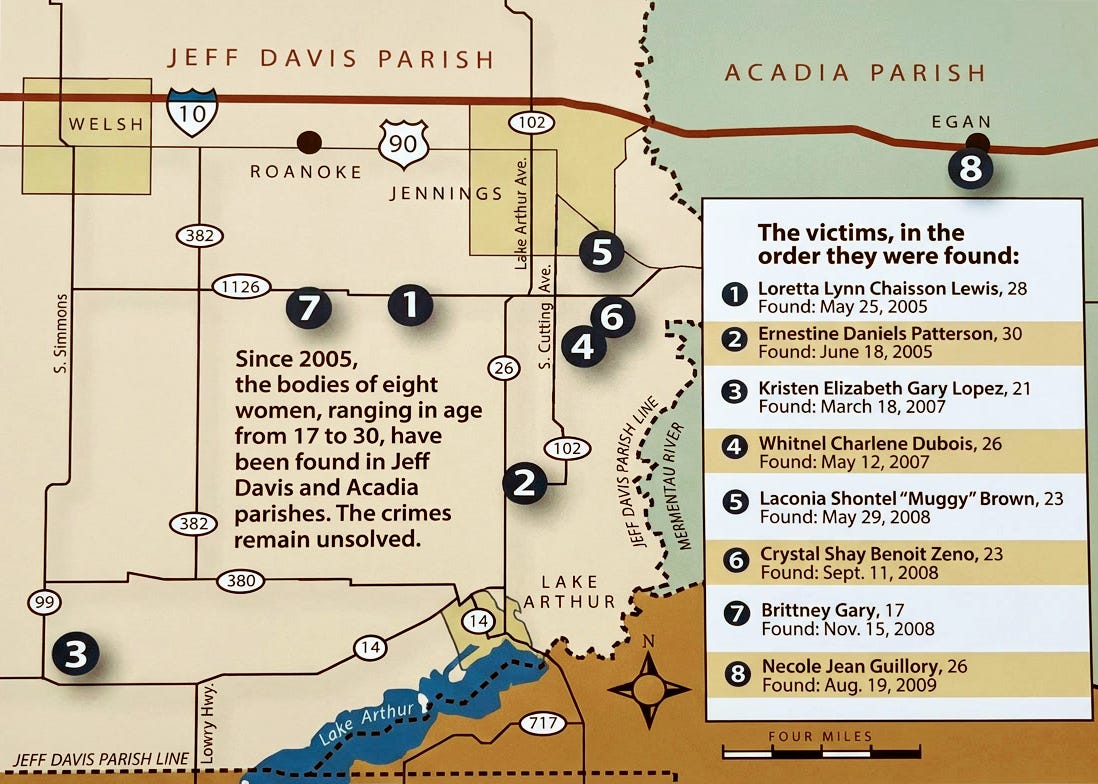
A fisherman works the east fork of the Grand Marais on a morning in May 2005, five miles outside Jennings, off Louisiana Highway 1026. Something pale turns over in the water. Actually, it’s someone. A young woman.
Loretta Lynn Chaisson Lewis was twenty-eight years old.
Not long before, she told her family the Jennings police arranged for her to be a spy, reporting back to them on a drug deal.
The medical examiner found cocaine and alcohol in her body. Cause of death, undetermined. Twenty-one years later, it’s still undetermined.
Ernestine Marie Daniels Patterson came out of a canal off Louisiana Highway 102 on June 18, 2005, five miles south of where the fisherman found Loretta. Somebody had cut Ernestine’s throat. The wounds on her wrists proved she fought somebody. Hers is the one death of the eight that Jefferson Davis Parish Sheriff’s Office classifies outright as a homicide.
Kristen Gary Lopez, twenty-one, nude in water in March 2007, wore a single sock on her left foot.
Whitnei Dubois, twenty-six, police found naked beside a public road south of Welsh that May.
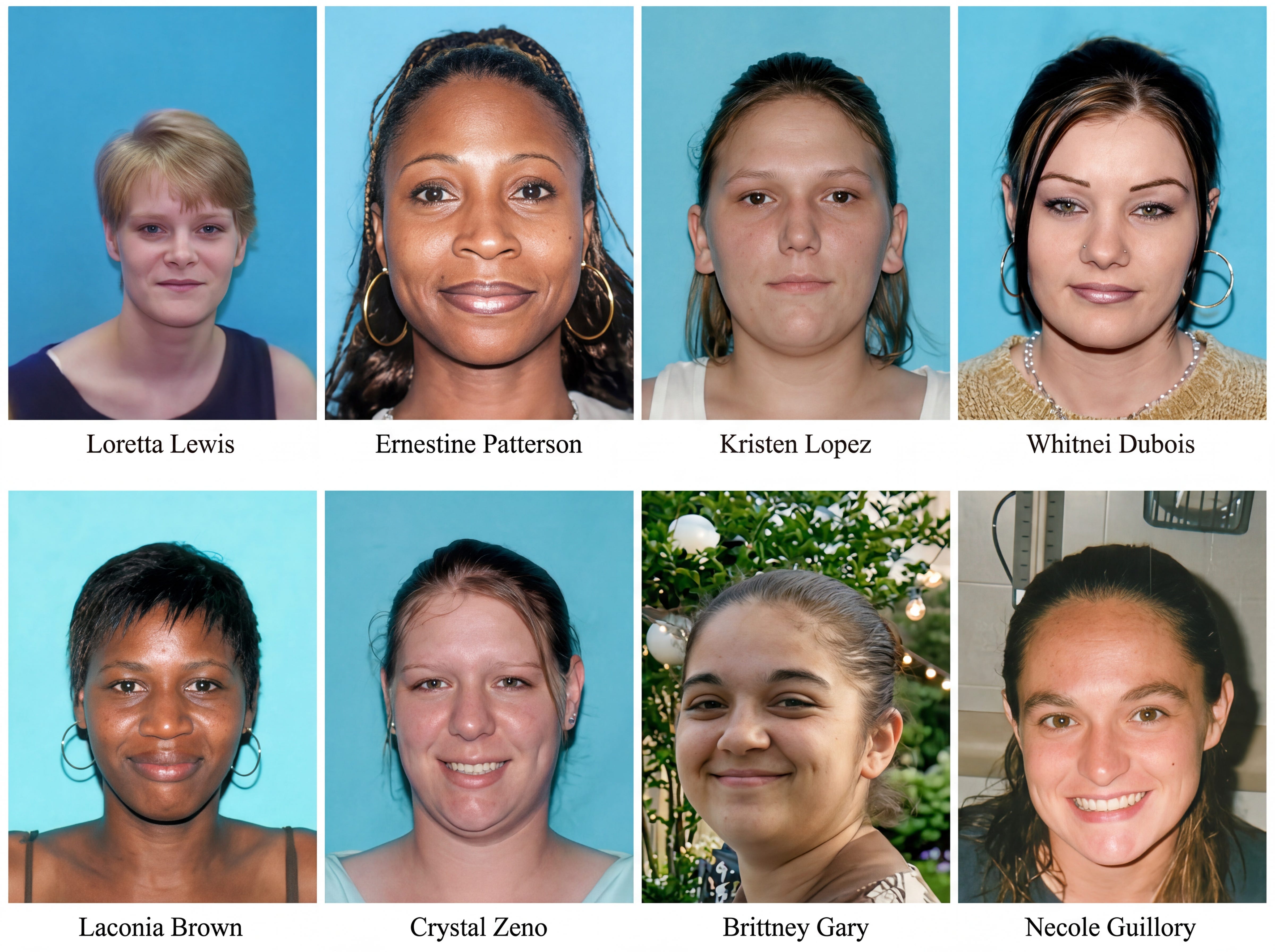
Laconia Shontel “Muggy” Brown, twenty-three, lay, doused in bleach on a roadside in May 2008, with seven slashes across her neck and three more cuts behind her right ear.
Hunters caught an odor in the woods on September 11, 2008. What they found there took the examiner until November 7 to identify as Crystal Shay Benoit Zeno, twenty-four.
A dollar store camera recorded seventeen-year-old Brittney Gary on November 2, 2008. Two weeks later she lay in the weeds by a Jennings highway. An officer said he reconized her tattoo, the most anyone could tell by what remained of her.
Necole Jean Guillory, twenty-six, lay at the bottom of a hill near Egan Ballpark in Acadia Parish. Highway workers found her on August 19, 2009, seven hours after her family reported her missing.
The Jennings Daily News, in its August 7 account of the case, told readers the eight bodies turned up between May 2005 and April 2009. Necole was found in August. Two decades on, the paper that covers the sheriff’s office is four months off on the last of the eight.
And even that may not gives us an accurate count.
Before any of the others there was Sheila Comeaux. Somebody beat her to near death outside Jennings in 1998. She spent a year in a hospital bed before succumbing to her injuries, March 19, 1999.
Shiela’s daughter, Lakesha Myers, told Showtime cameras in 2019 that her mother ran with the same crowd and snitched for the same police. Lakesha believes somebody in Jennings can tie her mother’s death to the eight who followed. No task force officially counts Sheila among the others, but she cannot be forgotten.

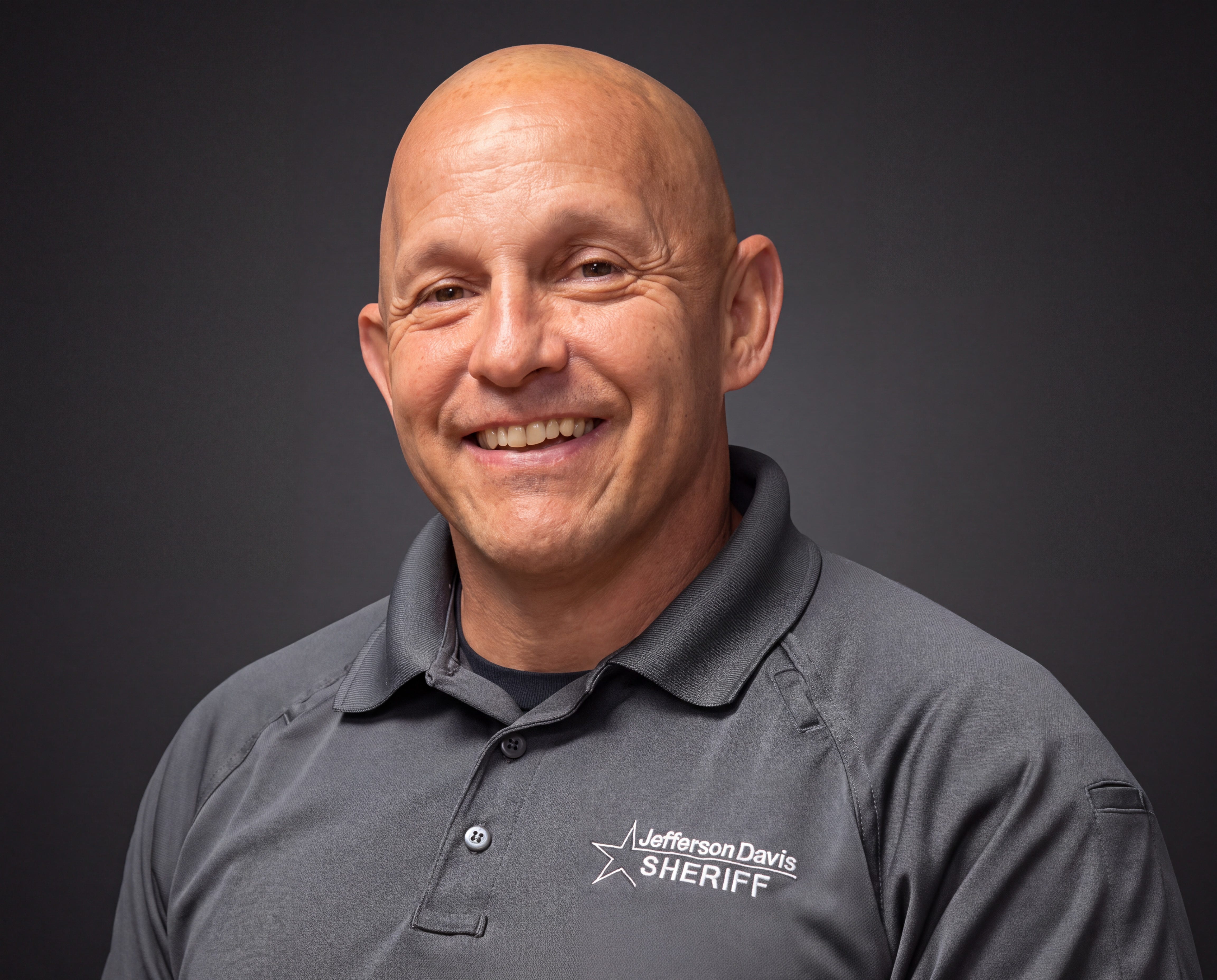
Sheriff Kyle Miers keeps his head shaved and his face clean. He’s fifty-one, medium build, a high school football player who took up jujitsu as a grown man. His administration inherited all eight cases in July 2024.
On August 7, 2026, he provided the Jennings Daily News with the progress report he promised when he campaigned for the office.
“As of July 1, we have dedicated approximately 3,800 hours toward those cases,” Miers said, “and we’ve produced over 1,300 pages of documentation.”
He said his detectives did not take up the investigation where the last investigators stopped.
“When we began this process, detectives made a decision to start from the beginning rather than pick up where others left off,” Miers said.
Think about that.
A sheriff’s office seldom rebuilds a twenty-year murder file from scratch unless they doubt the work that came before.
Now, Miers didn’t say that. The paper didn’t ask him. That’s all me.
Miers can’t discuss evidence from open cases, and he won’t discuss how his detectives are working the case. He won’t name a person of interest. He won’t say which outside agencies are helping him, because naming them, he says, may compromise the investigation.
He did repeat his campaign promise: “We want to reaffirm our unwavering commitment to pursuing justice.”
In the same interview, Miers reported that his detectives handled 626 other cases over the last six months, better than a hundred a month, closing seventy percent of them and making forty-four arrests.
Seven out of ten on everything else. Zero out of eight on these.
Sheriff Ricky Edwards held the office while the bodies were still turning up, and he described the women as living “a high-risk lifestyle” that included drugs and prostitution. That phrase did years of damage in Jefferson Davis Parish, and the voters resented his excuses.
Miers opened a door his predecessors kept shut.
“I have made contact with some family members,” he told the paper, “and if any immediate family member of any young lady would like to talk, my door is open for you.”
Having an open door is important. It is not a name, and not a cause of death for six of these eight (or nine) women.
I have been writing about Jennings since 2019, and I still can’t tell you how most of them died. Neither, on the record, can the coroner.
The Crime Stoppers reward for information on the eight murders stood at $85,000 in 2019. Nobody ever collected it.
The sheriff’s 3,800 hours divide out to about 475 hours per victim.
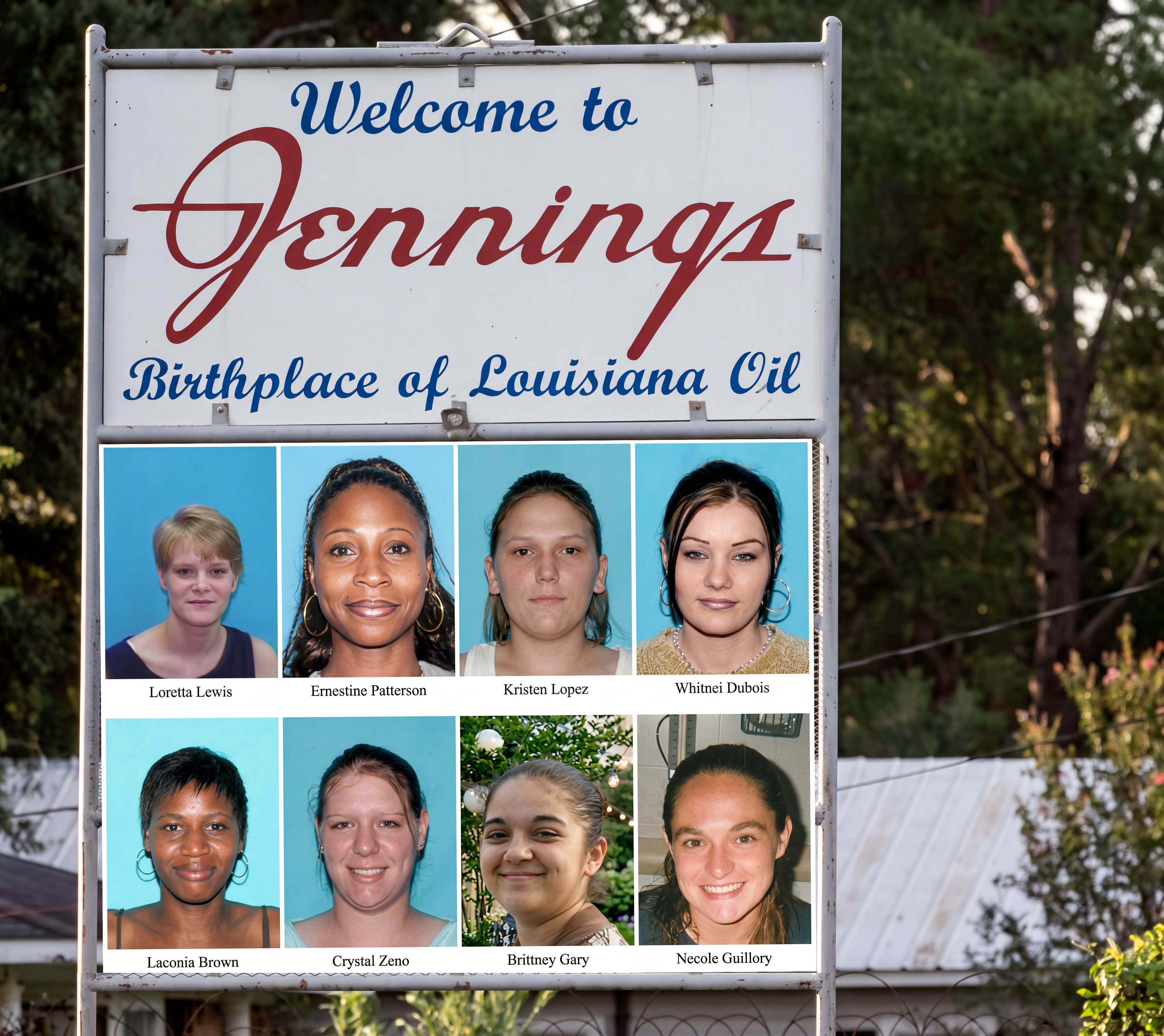
Twenty-one years after a fisherman found Loretta in the Grand Marais, that number is the most anybody in Jefferson Davis Parish has ever reported. So, it’s a start.
Let’s see what happens next.
Thursday, I plan to revisit what the sheriff’s office must have spent these months revsiting, including investigating some who wore the same uniform. I also want to revist the two suspects the television documentaries never got around to, and the motel stories that muddied the whole case.
And yes, I’ll discuss the last thing Frankie Richard told me before he died.
Until then, if you have information about the deaths of these women, contact Crime Stoppers or the Jefferson Davis Parish Sheriff’s Office.